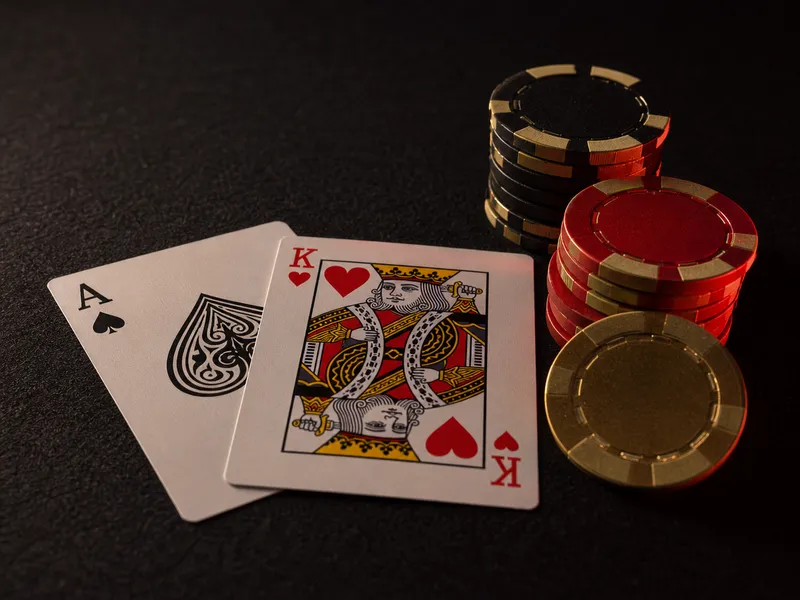
Blackjack
Also known as: 21, Twenty-One
Quick Rules
- Get your hand's total closer to 21 than the dealer's, without going over ("busting").
- Number cards = face value, face cards = 10, Aces = 1 or 11, whichever helps your hand more.
- "Hit" to take another card, "Stand" to keep your current total.
- A two-card 21 (Ace plus a 10-value card) is a "Blackjack" and usually pays 3:2 instead of even money.
- The dealer has no choices to make: hit on 16 or less, stand on 17 or more, always.
How to Play (Quick Overview)
- 1
Each player places a bet, then the dealer deals two cards to every player and two to themselves, with one dealer card dealt face down (the "hole card").
- 2
Each player acts in turn: "Hit" to take another card, or "Stand" to keep the current total. A player can hit as many times as they like as long as their total doesn't exceed 21.
- 3
If a player's total goes over 21, they "bust" and immediately lose their bet, regardless of what the dealer ends up with.
- 4
Where the table allows it, a player may also "Double down" (double the bet, take exactly one more card, then automatically stand), "Split" (if the first two cards match in rank, separate them into two hands with an equal bet on each), or "Surrender" (forfeit half the bet to end the hand early).
- 5
Once every player has finished acting, the dealer reveals their hole card and must hit until their total reaches 17 or more, then stands - the dealer has no choice in this.
- 6
Compare totals: a player who beats the dealer without busting wins their bet; a tie ("push") returns the bet; a lower total or a bust loses the bet.
Objective
Beat the dealer by getting your hand’s total closer to 21 than theirs, without going over 21 yourself.
Setup
Blackjack is played against a dealer, not against the other players at the table. Each player places a bet before any cards are dealt. The dealer deals two cards to each player and two cards to themselves - one of the dealer’s cards is dealt face up, and one face down (the “hole card”).
Card values: number cards 2-10 count at face value, face cards (King, Queen, Jack) count as 10, and an Ace counts as either 1 or 11, whichever gives the better total for the hand it’s in.
How to Play
Starting to the dealer’s left, each player decides in turn how to play their hand:
- Hit: take another card from the deck. A player can hit repeatedly as long as their total stays at 21 or under.
- Stand: take no more cards and lock in the current total.
- Bust: if a hit pushes a player’s total over 21, they bust and lose their bet immediately - even if the dealer later busts too.
- Double down (where allowed): double the original bet, take exactly one more card, and then automatically stand regardless of the result.
- Split (where allowed): if a player’s first two cards are the same rank, they may split them into two separate hands, each with its own bet equal to the original, and play each hand out independently.
- Surrender (where allowed): forfeit half the original bet to end the hand immediately, before taking any other action.
Once every player has finished, the dealer reveals their face-down card. The dealer then follows a fixed rule with no decisions involved: hit on a total of 16 or less, stand on 17 or more (house rules vary on whether the dealer hits or stands on a “soft 17,” meaning 17 that includes an Ace counted as 11).
Scoring
Standard wins pay 1:1 - win $10, get $10. A “Blackjack” (a two-card 21, meaning an Ace plus any 10-value card, dealt as your first two cards) typically pays 3:2 instead, unless the dealer also has a Blackjack, in which case it’s a push. There’s no cumulative score across hands - each hand settles its own bet independently.
Winning
On each individual hand: if you’re closer to 21 than the dealer without busting, you win your bet; if you bust, you lose regardless of the dealer’s hand; if you tie the dealer’s total, it’s a push and your bet is returned. There’s no single “winner” of a full session beyond whoever is ahead on chips when the group stops playing.
Variations
- Insurance: a side bet offered when the dealer’s face-up card is an Ace, betting that the dealer has Blackjack.
- Spanish 21: played with a deck that has all the 10s removed, offset by more generous payout rules.
- Home and casual games often skip surrender entirely and may limit doubling/splitting to simplify play - agree on which options are in play before starting.
History
Blackjack descends from European gambling games built around reaching a target number, most notably the French game Vingt-et-Un (“Twenty-One”), which spread to North America with French colonists and settlers in the 18th century. The distinctive name “Blackjack” and a 3:2 bonus payout for a natural Ace-plus-black-Jack hand were promotional gimmicks used by early 20th-century American casinos to drum up interest in the game - the name stuck even after most casinos later dropped that specific bonus rule in favor of paying 3:2 on any natural 21.
Fun Fact
Card counting, made famous in casino lore and Hollywood films, is legal in most jurisdictions since it only requires memory and attention rather than any device or outside help - though casinos remain just as free to ban or eject any player they suspect of doing it.