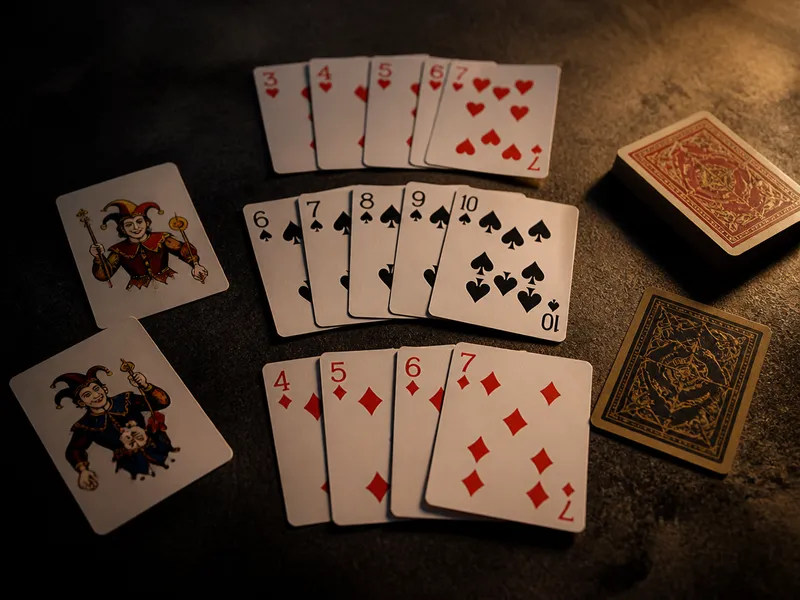
Canasta
Quick Rules
- Best played as 4 in fixed partnerships; melds are shared and built by the whole team, not just one player.
- Melds must contain at least 3 cards of the same rank; a completed 7+ card meld is a "canasta" and scores a big bonus.
- Jokers and 2s are wild, but a meld can only include as many wild cards as natural cards.
- You may only take the discard pile if you can immediately meld with the top card, and it's often frozen until certain conditions are met.
- A team must go out with at least one canasta completed; going out ends the hand and points are tallied for both teams.
How to Play (Quick Overview)
- 1
Shuffle two 52-card decks with 4 jokers added (108 cards total) and deal 11 cards to each player; place the rest face down as the stock, with the top card turned face up to start the discard pile.
- 2
On your turn, draw either the top 2 cards of the stock, or the entire discard pile (only if you can immediately use its top card to form or add to a meld, and the pile isn't currently "frozen" against you).
- 3
Lay down melds of 3 or more cards of the same rank, shared on the table for your whole partnership; wild cards (jokers and 2s) can be added, but never more wild cards than natural cards in that meld.
- 4
Add extra matching cards from your hand to your own or your partner's existing melds on later turns.
- 5
Discard one card face up to end your turn, unless you're going out this turn.
- 6
A player may go out only once their partnership has completed at least one canasta (7+ cards in a single meld); going out ends the hand immediately and both sides tally their scores.
Objective
Working with your partner, build melds of matching cards - especially large 7-card-or-more “canasta” melds, which are worth a large bonus - and score more points than the opposing partnership over several hands.
Setup
Shuffle two standard 52-card decks together with all 4 jokers added, for 108 cards total. Canasta is best played by 4 people in two fixed partnerships, sitting across from their partner (2 and 6-player versions also exist). Deal 11 cards to each player. Place the remaining cards face down as the stock, and turn the top card face up to start the discard pile.
How to Play
On your turn, draw either the top 2 cards from the stock, or take the entire discard pile - but only if the top discard card can be used immediately to form a new meld or extend an existing one of your side’s, and only if the pile isn’t currently “frozen” (marked unavailable until a natural pair matching its top card is used to unfreeze it, a rule that applies especially once a wild card has been discarded into the pile).
Melding. A meld is 3 or more cards of the same rank, laid face up on the table where it belongs to your whole partnership, not just you. Jokers and 2s are wild and can substitute for any rank in a meld - but a meld can never contain more wild cards than natural cards (so a meld can’t be built mostly or entirely from wilds). Aces and 3s have their own special restrictions in most rule sets: black 3s can only be discarded as your very last card when going out, and red 3s are bonus cards laid aside immediately rather than melded normally.
Once your side has melded, you can add more matching cards to your own or your partner’s existing melds on later turns, growing them toward a canasta.
Canasta. A meld that reaches 7 or more cards is a “canasta” - a “natural” canasta if it contains no wild cards, or a “mixed” canasta if it includes some. Canastas are the core scoring goal of the game.
End your turn by discarding one card face up, unless you’re going out this turn instead.
Scoring
At the end of a hand, each side scores points for every card in their melds:
- Jokers: 50 points each
- Aces and 2s: 20 points each
- 8s through Kings: 10 points each
- 4s through 7s, and black 3s: 5 points each
On top of that:
- A natural canasta (7+ cards, no wild cards) scores a 500-point bonus.
- A mixed canasta (7+ cards, including some wild cards) scores a 300-point bonus.
- Each red 3 held counts as a 100-point bonus (doubled to 200 if you hold all four) - but flips into a 100-point penalty per card instead if your side never manages to meld at all that hand.
- Subtract the value of every card still left in a player’s hand when the hand ends.
A partnership may only go out (playing their final card and ending the hand) once they have completed at least one canasta - going out without one isn’t allowed.
Winning
Play continues, hand after hand, with scores accumulating across the game. The first partnership to reach an agreed target score - commonly 5,000 points - wins the game.
Variations
- Two-player Canasta: each player draws additional cards each turn to compensate for having no partner to share melds with.
- Hand and Foot: a popular North American variant using far more decks and giving each player two full hands (a “hand” and a “foot”) to play through.
- Samba: adds sequences (runs of the same suit) as a second type of meld alongside same-rank melds.
History
Canasta was invented in Uruguay in 1939 or 1940, most commonly credited to Segismundo Nicolau and Alberto Serrato in Montevideo, as a variation on Rummy. It spread through South America during the 1940s before arriving in the United States around 1948-1949, where it triggered a brief but intense nationwide fad - for a couple of years in the early 1950s, Canasta reportedly rivaled Contract Bridge as the most popular card game in America, before interest cooled into steadier, more modest ongoing popularity.
Fun Fact
The Canasta fad of the early 1950s was intense enough that it reportedly strained the playing-card industry itself, with manufacturers scrambling to keep up with demand for the double-deck-plus-jokers packs the game requires - a level of sudden consumer demand rarely seen for a game with no single company or brand behind it.