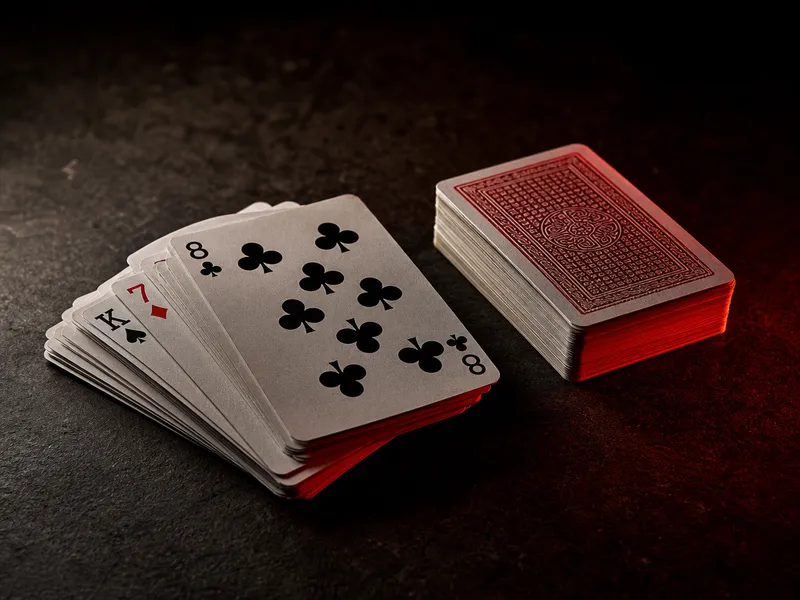
Crazy Eights
Also known as: Eights, Swedish Rummy
Quick Rules
- Match the top card of the discard pile by rank or suit, or play an 8.
- 8s are wild - the player who plays one names the next suit.
- No match and no 8? Draw one card from the stock. If it doesn't help, your turn ends.
- First player to discard their entire hand wins the round.
- If the stock runs out, shuffle the discard pile (except the top card) to make a new one.
How to Play (Quick Overview)
- 1
Deal 5 cards to each player (7 in a two-player game). Place the rest face down as the draw pile and flip the top card to start the discard pile.
- 2
On your turn, play one card from your hand that matches the rank or suit of the top discard, or play any 8.
- 3
If you play an 8, announce the suit that the next player must match - it can be any suit, including the one the 8 itself belongs to.
- 4
If you can't play, draw one card from the draw pile. If that card can be played, you may play it immediately; otherwise your turn passes.
- 5
When the draw pile is empty, reshuffle all but the top discard card to form a new draw pile.
- 6
Play continues until one player has no cards left, ending the round.
Objective
Be the first player to get rid of every card in your hand.
Setup
Use a standard 52-card deck (add a second deck if more than seven people are playing). Shuffle and deal 5 cards to each player, or 7 cards each if only two people are playing. Place the remaining cards face down as the draw pile, then turn the top card face up next to it to start the discard pile. If that first card is an 8, slide it into the middle of the deck and flip a new one instead.
How to Play
Play moves clockwise starting with the player to the dealer’s left. On your turn you must do one of the following:
- Play a card from your hand that matches the top discard’s rank (e.g., discard a 9 on a 9) or suit (e.g., discard any heart on a heart).
- Play an 8 at any time, regardless of the top card. Playing an 8 is a “wild” move: the player who plays it immediately names a suit, and the next player must follow that named suit (or play another 8).
- If you have no legal play, draw one card from the draw pile. If the drawn card can be played, you may play it right away. If not, your turn ends and play passes to the left.
There’s no limit to how many 8s can be played back-to-back - each one simply resets the required suit.
If the draw pile runs out before anyone goes out, take the discard pile, leave the current top card in place, shuffle the rest, and turn it into a new draw pile.
Scoring
Crazy Eights is usually played as a single round to see who goes out first, but for a running score across multiple hands, tally the cards left in every other player’s hand at the end of each round:
- 8s: 50 points each
- Face cards (K, Q, J) and 10s: 10 points each
- Ace through 9 (except 8s): face value (an Ace counts as 1)
The winner of the round scores zero; everyone else adds up the points still in their hand. Play several rounds and the player with the lowest total when you stop is the overall winner.
Winning
The first player to play their last card wins that round. If you’re tracking points across several rounds, the player with the lowest cumulative score when the group decides to stop is the winner.
Variations
- Draw-until-you-can-play: instead of drawing just once, some groups require drawing repeatedly until you get a playable card.
- Stacking penalty cards: some house rules let 2s force the next player to draw two, or Jacks skip the next player - agree on any extra wild cards before you start, since they aren’t part of the standard rules above.
- Draw-two ending: some groups don’t allow the last card played to be an 8, to prevent ending the hand on a wild card without naming a “real” suit.
History
Crazy Eights belongs to a family of shedding games played across Europe and North America since at least the early 20th century, closely related to games like Rockaway and Swedish Rummy. It caught on as a simple, equipment-free family game - just a standard deck and a few minutes of explanation - and became a staple of children’s game collections and scouting handbooks throughout the mid-1900s. Its core mechanic, matching by rank or suit with a wild card breaking the rule, is widely credited as the direct inspiration behind Mattel’s Uno, created a few decades later.
Fun Fact
Crazy Eights is the direct ancestor of Uno: inventor Merle Robbins built Uno in 1971 largely by taking Crazy Eights’ matching rule and making it more explicit - swapping suits for colors and turning informal house rules like “skip the next player” into printed, dedicated cards.