Cribbage
Quick Rules
- Each player is dealt 6 cards and discards 2 into a shared "crib" that belongs to the dealer.
- During "the play," cards are laid one at a time, adding up running totals - scoring points for hitting 15, 31, pairs, and runs, without ever exceeding 31.
- After the play, each hand (and the crib) is scored for combinations: 15s, pairs, runs, and flushes.
- A turned-up "starter" card counts as a 5th card for every scoring hand, including the crib.
- First player to peg 121 points (tracked on a cribbage board) wins the game.
How to Play (Quick Overview)
- 1
Deal 6 cards to each player. Each player looks at their hand and discards 2 cards face down into "the crib," a 4-card hand that belongs to the dealer and is scored at the end of the hand.
- 2
Cut the remaining deck and turn up the top card as the "starter." If it's a Jack, the dealer immediately pegs 2 points ("his heels").
- 3
Play "the play": starting with the non-dealer, players alternate laying one card face up, announcing the new running total, which must never exceed 31. Score points during this phase for reaching exactly 15 or 31, pairs, and runs formed by the last few cards played.
- 4
If a player cannot play without exceeding 31, they say "go" and the other player scores 1 point for the go (or 2 if they hit exactly 31) and continues playing cards if they still can.
- 5
Once neither player can play, reset the count to 0 and continue laying cards from where you left off until both hands are fully played.
- 6
Score each hand in turn - non-dealer's hand first, then dealer's hand, then the crib (using the starter card as a 5th card in all three) - for combinations worth points: 15s, pairs, runs, and flushes.
Objective
Be the first player to peg 121 points on the cribbage board, earned across the play and the hand- scoring that follows each deal.
Setup
Shuffle a standard 52-card deck. Deal 6 cards to each of the two players. Each player then looks at their hand and sets aside 2 cards face down to form “the crib” - a 4-card hand that belongs to the dealer and gets scored at the end of the round, giving the dealer a built-in scoring advantage that alternates each hand. After discarding to the crib, the non-dealer cuts the remaining deck, and the dealer turns the top card face up as the “starter.” If the starter is a Jack, the dealer scores 2 points immediately (called “his heels”).
How to Play
The play. Starting with the player who is not the dealer, players alternate laying one card face up onto a shared pile, each announcing the running total of all cards played so far (face cards count as 10, Ace counts as 1). The running total may never be pushed over 31. As cards are played, score points for:
- Reaching exactly 15: 2 points.
- Reaching exactly 31: 2 points.
- Playing a card that pairs the previous one: 2 points (and more for three or four in a row).
- Completing a run of 3 or more consecutive ranks using the most recently played cards, in any order: 1 point per card in the run.
If a player cannot play any card without exceeding 31, they say “go,” and their opponent scores 1 point (called “the go”), or 2 points if their card brings the total to exactly 31. Play then resets the running count to 0 and continues with whatever cards remain, until both players have played their entire hand.
Scoring the hands. Once the play is finished, each hand is scored in turn using its 4 original cards plus the shared starter card as a 5th card: first the non-dealer’s hand, then the dealer’s hand, then the dealer’s crib. Score each hand for:
- Any combination of cards adding to 15: 2 points each.
- Pairs: 2 points; three of a kind: 6 points; four of a kind: 12 points.
- Runs of 3 or more consecutive ranks: 1 point per card in the run.
- A flush: 4 points if all 4 hand cards share a suit (5 points if the starter matches too); the crib requires all 5 cards, including the starter, to match for any flush points at all.
- Holding the Jack matching the starter’s suit (“his nobs”): 1 point.
Winning
Play continues, hand after hand (with the dealer role alternating), pegging points on the cribbage board as they’re scored. The first player to peg exactly 121 points wins the game immediately - even mid-count, before the rest of a hand is fully scored.
Variations
- Muggins: a stricter house rule where if a player misses points they were entitled to during hand-scoring, their opponent may claim those points instead.
- 3 or 4-player Cribbage: adaptations that add a second crib contribution from each player, or use partnerships, to keep the deal working with more players.
- Five-card Cribbage: an older variant dealing only 5 cards each, discarding 1 into a smaller crib, and playing to 61 points instead of 121.
History
Cribbage is credited to the 17th-century English poet and courtier Sir John Suckling, who adapted it from an earlier English game called Noddy sometime in the 1630s. It’s one of the few widely played card games with a well-documented single inventor and approximate invention date, and its core rules have stayed largely unchanged for nearly four centuries since.
Fun Fact
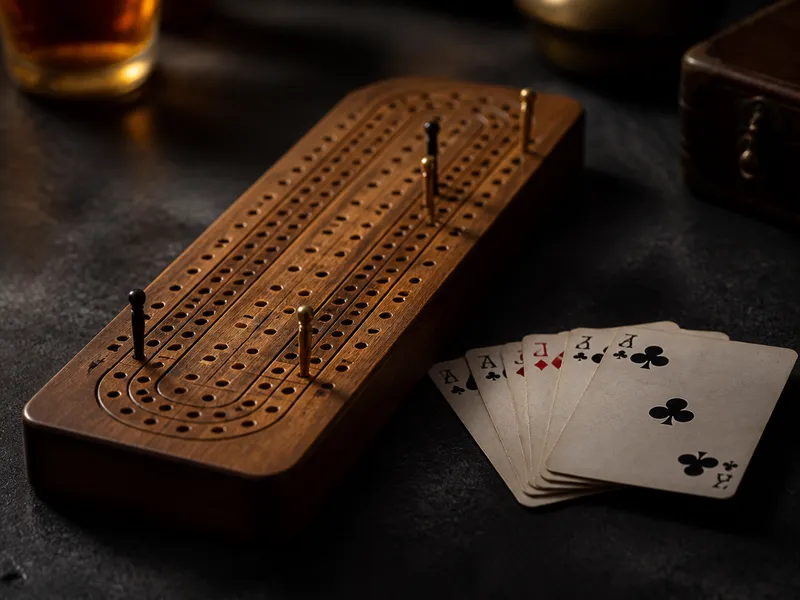
The cribbage board used for scoring - with its rows of holes and pegs - exists because Cribbage was historically played in taverns and aboard ships, reportedly including Royal Navy vessels, where a physical pegging board was far more practical for keeping score than pencil and paper in low light or rough seas.