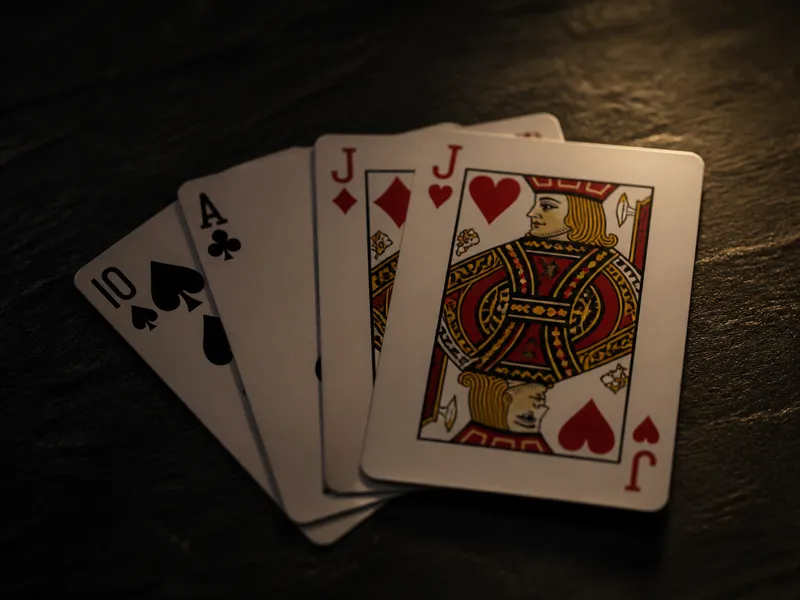
Euchre
Quick Rules
- Uses a short 24-card deck (9, 10, J, Q, K, A in each suit) split into two fixed partnerships.
- After the deal, players bid to pick trump by accepting or passing on the turned-up card, or naming a suit.
- The Jack of the trump suit ("right bower") is the highest card in play; the same-color Jack ("left bower") is second-highest and counts as trump.
- The partnership that named trump must take at least 3 of the 5 tricks or they're "euchred" and the other team scores instead.
- First partnership to reach 10 points wins the game.
How to Play (Quick Overview)
- 1
Deal 5 cards to each player (in batches of 2-3 or 3-2) from the 24-card Euchre deck, then turn the next card face up as the proposed trump.
- 2
Starting left of the dealer, each player in turn may "order up" the turned card (accepting it as trump, with the dealer picking it up and discarding one card) or pass.
- 3
If everyone passes on the turned suit, a second round lets each player name any other suit as trump instead (or the whole hand is thrown in, depending on house rules, if everyone passes twice).
- 4
Once trump is set, the player left of the dealer leads the first of 5 tricks; others must follow the suit led if able, remembering that the left bower counts as a trump card, not its printed suit.
- 5
The highest trump played wins the trick if any trump was played; otherwise the highest card of the suit led wins. The trick winner leads next.
- 6
After all 5 tricks are played, score the hand based on how many tricks the trump-calling team won.
Objective
Partnering with the player across from you, either win at least 3 of the 5 tricks in a hand where your side named trump, or stop the other partnership from doing the same.
Setup
Euchre uses a stripped-down 24-card deck: only the 9, 10, Jack, Queen, King, and Ace of each suit. Four players sit in two fixed partnerships, partners across from each other. Deal 5 cards to each player, then turn the next card of the deck face up - this is the proposed trump suit for the hand.
How to Play
Naming trump. Starting with the player to the dealer’s left, each player in turn may “order up” the turned card, accepting its suit as trump for the hand (the dealer then picks up that card and discards one card from their hand face down), or pass. If everyone passes, a second round goes around where each player may instead name any suit other than the turned one as trump. If everyone passes on both rounds, house rules vary: some redeal, some “throw in” the hand for no score.
Card ranking under trump. Once trump is set, ranking is unusual: the Jack of the trump suit is the highest card in the entire hand, called the right bower. The Jack of the same color (for example, the Jack of clubs when spades is trump) is the second-highest card and counts as a trump card despite its printed suit - this is the left bower. Below those two, trump cards rank Ace, King, Queen, 10, 9. Non-trump suits rank normally, Ace high down to 9.
Playing tricks. The player left of the dealer leads the first trick. Other players must follow the suit led if they can - remembering the left bower counts as trump, not its printed suit, for following-suit purposes. If any trump is played in a trick, the highest trump played wins it; otherwise the highest card of the suit led wins. Play 5 tricks total.
Any player (or side) may also choose to “go alone,” playing without their partner’s cards on the table in exchange for a bigger score if they succeed.
Scoring
- The partnership that named trump takes 3 or 4 tricks: 1 point.
- The partnership that named trump takes all 5 tricks (“a march”): 2 points.
- The partnership that named trump takes fewer than 3 tricks (they’re “euchred”): the other partnership scores 2 points instead.
- Going alone and winning all 5 tricks scores 4 points instead of 2.
Winning
Play hands one after another, with the dealer position rotating clockwise. The first partnership to reach 10 points wins the game.
Variations
- Stick the dealer: a house rule forcing the dealer to name a trump suit if everyone passes on both rounds, rather than redealing or throwing in the hand.
- No-trump / “Jump” bids: some variants let a player call the hand with no trump suit at all, or allow bidding beyond a simple accept-or-pass.
- 3 or 6-player Euchre: adaptations exist without fixed partnerships, changing the trick-taking dynamics considerably from the standard 4-player partnership game above.
History
Euchre is believed to have developed from the German game Juckerspiel, brought to the United States by German immigrants in the 19th century - the name “Euchre” and its most distinctive feature, the “bowers” (from the German word Bauer, meaning farmer or Jack), both trace back to that German- language origin. It became especially popular in the American Midwest, where it remains a strong regional tradition today, notably in Michigan and Ohio.
Fun Fact
Euchre is credited by some card historians as the game responsible for introducing the Joker into the standard modern deck - added in the mid-19th century specifically as an extra trump card for certain Euchre variants, long before the Joker found its way into countless other games and became a permanent fixture of the 52-plus-jokers pack sold today.