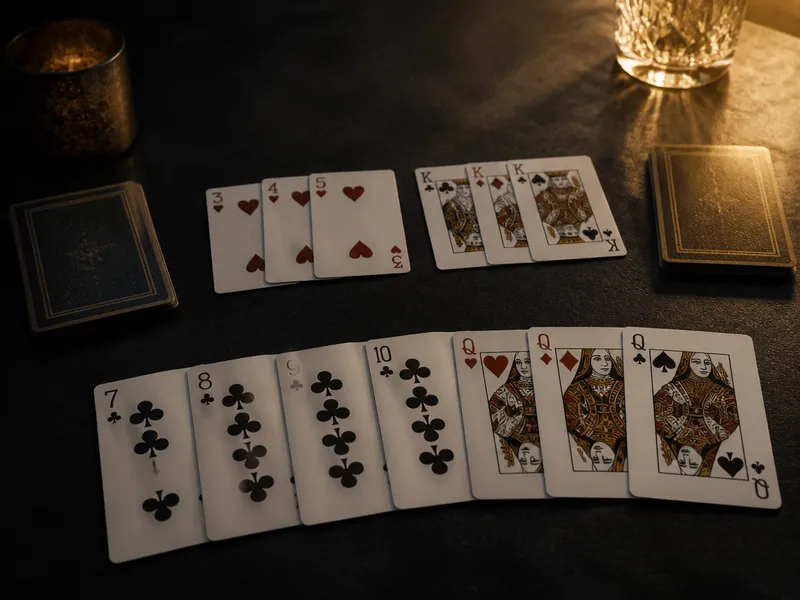
Gin Rummy
Also known as: Gin
Quick Rules
- Each player holds 10 cards; the goal is to form sets (3-4 of a kind) and runs (3+ consecutive cards, same suit).
- Every turn: draw one card (from the stock or the discard pile), then discard one card.
- "Knock" once your unmatched cards (deadwood) total 10 points or less, ending the hand.
- Deadwood value: face cards = 10, Aces = 1, everything else = pip value.
- If your deadwood is lower than your opponent's after they lay off cards, you score the difference; if theirs is equal or lower, they "undercut" you and score the difference plus a 25-point bonus.
How to Play (Quick Overview)
- 1
Deal 10 cards to each player. Place the rest face down as the stock and turn the top card face up beside it to start the discard pile.
- 2
On your turn, draw the top card from either the stock or the discard pile.
- 3
Arrange your hand into sets (three or four of the same rank) and runs (three or more consecutive cards in one suit) - leftover cards are your "deadwood."
- 4
Discard one card face up, ending your turn.
- 5
Once your deadwood totals 10 points or less, you may knock instead of discarding normally: lay down your sets, runs, and remaining deadwood.
- 6
Your opponent then lays down their own hand and may "lay off" any of their deadwood cards onto your exposed sets and runs where legal, before deadwood is compared.
Objective
Arrange your hand into sets and runs faster than your opponent, and end the hand with less leftover, unmatched “deadwood” than they have.
Setup
Shuffle a standard 52-card deck. Deal 10 cards to each of the two players. Place the remaining cards face down as the stock pile, and turn the top card face up next to it to start the discard pile.
How to Play
On your turn, draw the top card from either the stock pile or the discard pile. Then arrange your 10 cards into:
- Sets: three or four cards of the same rank (e.g., 7-7-7).
- Runs: three or more consecutive cards in the same suit (e.g., 4-5-6 of clubs).
Any card that isn’t part of a set or run counts as deadwood. After drawing, discard one card face up onto the discard pile, ending your turn.
Once your deadwood totals 10 points or less, you have the option to “knock” instead of discarding as normal. To knock, lay your hand face up on the table, organized into your sets, runs, and any leftover deadwood. Your opponent then lays their own hand face up, and may “lay off” any of their own deadwood cards onto your exposed sets and runs (for example, adding a fourth card to your three-of-a-kind), reducing their deadwood total before it’s compared to yours.
If all of your 10 cards belong to sets or runs with nothing left over, you have “gin.” You may go out with gin instead of a normal knock, and in this case your opponent isn’t allowed to lay off any cards at all.
Scoring
- Face cards (K, Q, J) count as 10 points of deadwood; Aces count as 1; number cards count at face value.
- Knock: if the knocker’s deadwood is lower than the opponent’s (after laying off), the knocker scores the point difference between the two deadwood totals.
- Undercut: if the opponent’s deadwood ends up equal to or lower than the knocker’s after laying off, the opponent scores the difference instead, plus a 25-point bonus, and the knock is “undercut.”
- Gin: going out with zero deadwood scores the full value of the opponent’s deadwood, plus a 25-point bonus, and the opponent cannot lay off any cards.
Hands are played one after another, with scores accumulating on a running scoresheet.
Winning
Play continues, hand after hand, until one player’s cumulative score reaches 100 points (the traditional target, though any agreed number works). That player wins the game, and often receives an additional flat game bonus.
Variations
- Big Gin: some variants let you go out with all 11 cards matched (after drawing a card that completes your hand with zero deadwood) for a bigger bonus.
- Oklahoma Gin: the value of the first upcard sets the maximum deadwood you’re allowed to knock with that hand.
- Hollywood Gin: three separate games are scored simultaneously on one scoresheet, so a single hand can affect multiple running totals at once.
History
Gin Rummy was devised around 1909 by Elwood T. Baker, a whist instructor in New York, together with his son C. Graham Baker, as a faster-playing variant of Whiskey Poker and the older Spanish/Mexican rummy game Conquian. The name “Gin” is generally thought to be a playful nod to the earlier game Rummy, the same way the drink gin relates to rum. It spread through New York social clubs in the 1910s and 20s, then became a favorite pastime among Hollywood actors on film sets in the 1930s and 40s, which helped push it into wider national popularity.
Fun Fact
The “knock” mechanic - ending a hand early once your unmatched deadwood drops low enough, instead of needing a fully completed hand - was a genuine innovation when Gin Rummy was invented, and it’s the single feature most responsible for making the game noticeably faster than the rummy variants that came before it.