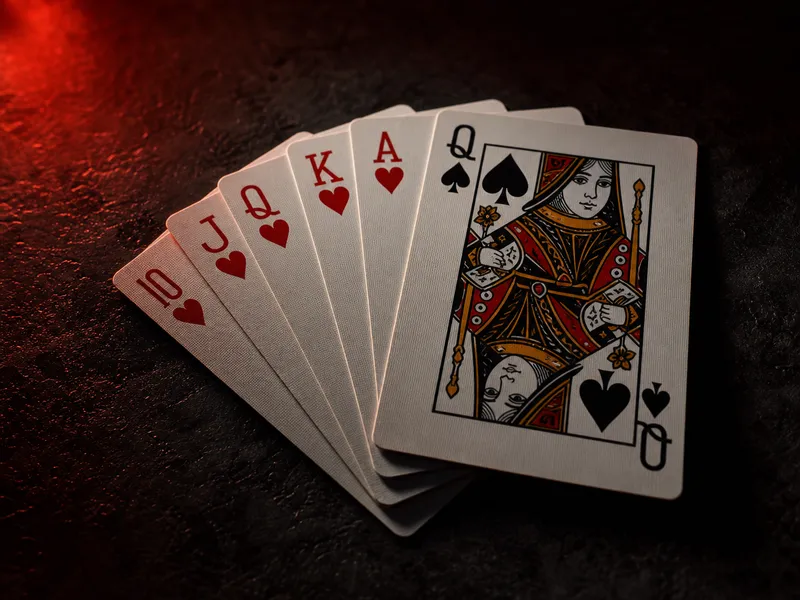
Hearts
Quick Rules
- Goal: avoid taking Hearts (1 point each) and the Queen of Spades (13 points).
- Before play, each player passes 3 cards to an opponent (direction rotates each hand).
- Whoever holds the 2 of clubs leads first; you must follow suit if you can.
- Hearts can't be led until a Heart or the Queen of Spades has already been played ("hearts broken").
- Lowest total score when someone hits 100 wins; "shooting the moon" (taking every Heart plus the Queen) scores you 0 and everyone else 26.
How to Play (Quick Overview)
- 1
Deal all 52 cards evenly, 13 to each of the 4 players.
- 2
Each player chooses 3 cards to pass to another player before play begins - direction rotates hand to hand: left, then right, then across, then no pass at all.
- 3
The player holding the 2 of clubs leads the first trick; other players must follow the suit led if they're able to.
- 4
If a player has no card of the led suit, they may play any card, including a Heart or the Queen of Spades.
- 5
The highest card of the suit that was led wins the trick; that player leads the next trick.
- 6
Hearts cannot be led until a Heart (or the Queen of Spades) has already been played in an earlier trick, unless a player has nothing but Hearts left to play.
Objective
Finish each hand with as few penalty points as possible. Hearts is a game you play to lose, not to win tricks.
Setup
Shuffle a standard 52-card deck and deal all of it out evenly, 13 cards to each of the 4 players. Before the first trick, every player chooses 3 cards from their hand to pass to another player. The direction of the pass rotates each hand: to the left on the first hand, to the right on the second, across the table on the third, and no pass at all on the fourth - then the cycle repeats.
How to Play
Whoever holds the 2 of clubs leads the very first trick of the game. Other players must follow the suit that was led if they hold a card of that suit. If a player has none of the led suit, they may play any card from their hand, including a Heart or the Queen of Spades.
The highest-ranked card of the suit that was led wins the trick (Ace is high); the winner of a trick leads the next one.
Two restrictions shape how the early tricks play out:
- No penalty cards in the first trick. Nobody may play a Heart or the Queen of Spades on the very first trick of the hand, even if they can’t follow suit.
- Hearts can’t be led until “broken.” A player can’t lead a Heart until a Heart (or the Queen of Spades) has already been played on some earlier trick - unless that player has nothing but Hearts left in their hand, in which case they must lead one anyway.
Play continues until all 13 tricks have been taken.
Scoring
At the end of the hand, count penalty points from the cards each player took in tricks:
- Every Heart: 1 point
- The Queen of Spades: 13 points
Add up each player’s total for the hand. The exception is shooting the moon: if a single player takes every Heart and the Queen of Spades in one hand, they score 0 points for that hand instead, and every other player scores 26 points.
Winning
Hands are played one after another, with scores accumulating across the game. Once any player’s total reaches 100 points, the hand in progress finishes, and the player with the lowest total score wins the game.
Variations
- Omnibus Hearts: adds the Jack of Diamonds as a bonus card worth -10 points to whoever takes it.
- No-pass hands: some groups skip the card-passing step entirely and play every hand as a straight deal.
- 3-6 player Hearts: less common adaptations remove or add cards from the deck to keep the deal even across a different number of players; the version above is standard 4-player Hearts.
History
Hearts belongs to a family of European trick-avoidance games - games built around dodging certain cards rather than collecting tricks - that includes the older Spanish game Reversis. The American version built specifically around avoiding Hearts and the Queen of Spades took shape in the United States by the 1880s, evolving out of that broader European tradition. The now-standard step of passing three cards to another player before play begins was added later, as a way to soften the impact of a genuinely bad initial deal.
Fun Fact
“Shooting the moon” - deliberately trying to capture every single penalty card in a hand instead of avoiding them - flips the entire logic of the game on its head, and it’s one of the more famous high-risk, high-reward mechanics in any widely played card game, since a failed attempt can cost you far more than simply playing it safe.