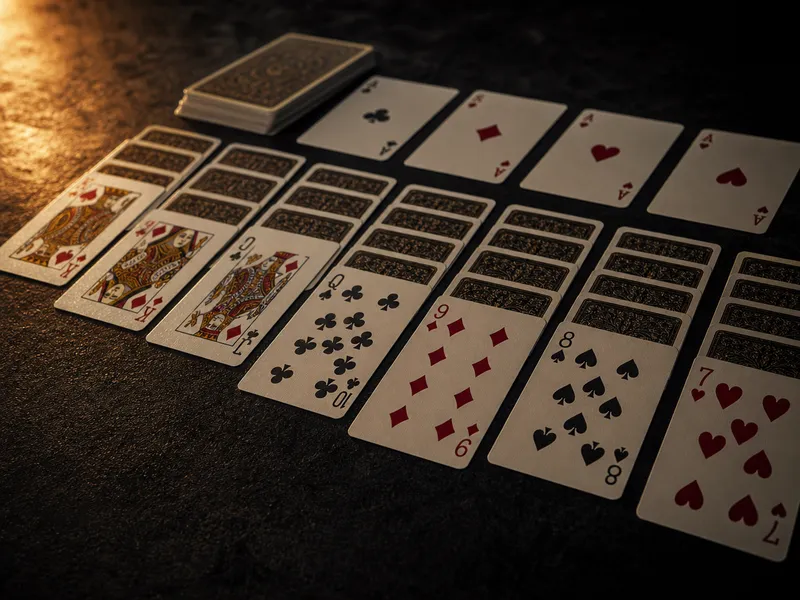
Klondike Solitaire
Also known as: Solitaire, Patience
Quick Rules
- Build the tableau: 7 columns, each with one more card than the last, only the top card of each face up.
- Move cards between tableau columns in descending order, alternating red and black colors.
- Build the four foundation piles up from Ace to King, one suit per pile, to win the game.
- Only a King (or, in some variants, any card) can fill an empty tableau column.
- Flip through the leftover stock 1 or 3 cards at a time whenever the tableau has no moves left.
How to Play (Quick Overview)
- 1
Deal 7 columns face down and face up: column 1 has 1 card, column 2 has 2, up to column 7 with 7 cards - only the top card of each column is dealt face up.
- 2
Place the remaining 24 cards face down as the stock pile.
- 3
On the tableau, move a face-up card, or a valid face-up sequence, onto another column if it's exactly one rank lower and the opposite color, for example a black 7 onto a red 8.
- 4
Whenever a face-down card becomes the top card of its column, flip it face up.
- 5
Turn cards from the stock into a waste pile, one at a time or three at a time depending on the variant being played - the top card of the waste pile is available to play onto the tableau or a foundation.
- 6
Build the four foundation piles up in suit from Ace through King; you win once all 52 cards are moved onto the foundations.
Objective
Move all 52 cards onto the four foundation piles, sorted by suit from Ace up to King.
Setup
Shuffle a standard 52-card deck. Deal out 7 columns to form the tableau: the first column gets 1 card, the second gets 2, the third gets 3, and so on up to the seventh column with 7 cards. In every column, only the top card is dealt face up - all the cards underneath stay face down. Place the remaining 24 cards face down to one side as the stock pile.
How to Play
You have three areas to work with: the tableau (the 7 columns), the stock (and the waste pile it deals into), and the foundations (4 empty piles you build up by suit).
On the tableau, you may move a face-up card - or a whole face-up sequence of cards - onto another column, as long as the card it’s landing on is exactly one rank higher and the opposite color (for example, a red 6 can go onto a black 7). Whenever moving a card exposes a face-down card underneath, flip that card face up; it’s now available to play.
When you run out of tableau moves, turn cards over from the stock pile into a waste pile - either one card at a time or three at a time, depending on which version you’re playing. Only the top card of the waste pile is available to play, either onto the tableau (following the descending, alternating-color rule) or directly onto a foundation if it’s the next needed card.
An empty tableau column can only be filled by a King (in standard Klondike) - in some easier variants, any card can be used to fill an empty column.
Whenever an Ace becomes available, start a foundation pile with it, then build that pile upward in the same suit: 2, 3, 4, and so on up to King.
Scoring
Standard Klondike has no point score - it’s simply won or lost as a single game. Some digital versions award points for each card moved to a foundation, and deduct points based on time taken or the number of cards drawn from the stock, but this isn’t part of the traditional paper-and-cards game.
Winning
You win the moment all 52 cards have been moved onto the four foundation piles, each sorted correctly from Ace to King. If you run out of legal moves before that happens, the game is lost.
Variations
- Draw-1 vs. draw-3: the easier version turns one card at a time from the stock; the harder, standard casino version turns three at a time and only the top of those three is playable until it’s cleared.
- Vegas scoring: a scoring system that starts you at a negative balance (representing money paid to play) and pays out per card successfully moved to a foundation.
- Thoughtful Solitaire: a stricter variant where you’re assumed to know the identity of every face-down card, used to test whether a given deal is actually solvable.
History
Solitaire card games as a broad category are believed to have emerged in Northern Europe, especially the Baltic region and Scandinavia, in the late 18th century, originally as a way to pass time alone. The specific Klondike layout became the dominant version in North America by the late 19th century, though its exact inventor is unknown. Its name is thought to reference the Klondike Gold Rush of the 1890s, evoking solitary prospectors passing long hours alone with nothing but a deck of cards.
Fun Fact
Klondike became the default, pre-installed game on Windows PCs starting with Windows 3.0 in 1990, reportedly included specifically to teach a generation of new computer users how to use a mouse for dragging and dropping cards - making it arguably one of the most-played card games in history simply through sheer default exposure.