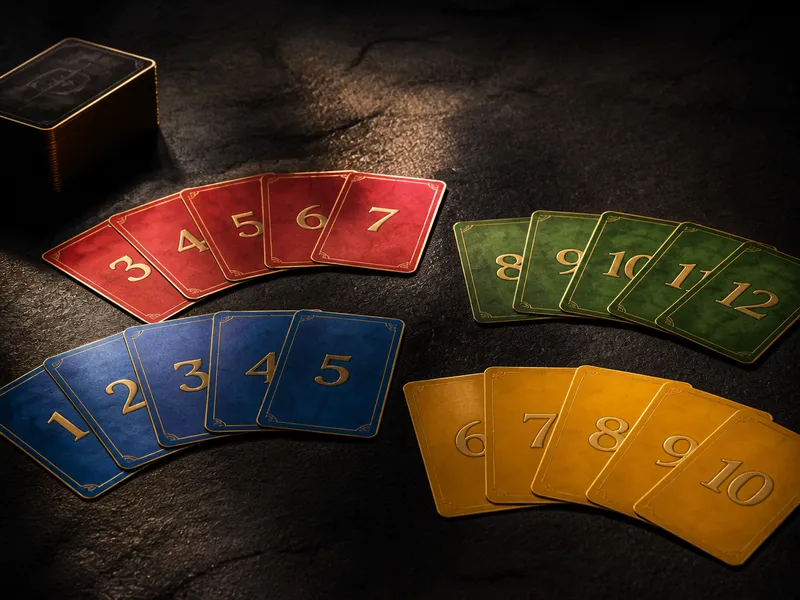
Phase 10
Quick Rules
- Each player works through the same 10 fixed "phases" (like 2 sets of 3, or a run of 7) in order, one per hand.
- Complete your current phase by laying it down on the table; you can't move to the next phase until you finish the current one.
- Draw one card each turn (from the deck or discard pile) then discard one, same as standard rummy.
- After you've laid down your phase, you may add extra matching cards onto your own or others' completed phases.
- First player to complete all 10 phases (over 10 separate hands) wins - lowest card total is the tiebreaker.
How to Play (Quick Overview)
- 1
Deal 10 cards to each player from the 108-card Phase 10 deck; place the rest face down as the draw pile, with the top card turned up to start the discard pile.
- 2
On your turn, draw one card from either the draw pile or the discard pile, then decide whether to attempt your current phase.
- 3
If your hand can complete your assigned phase (for example, "2 sets of 3" or "1 run of 7"), lay those cards face up on the table - you must complete the entire phase in one turn, not partially over several turns.
- 4
Once you've laid down your phase for the hand, you may also "hit" (add extra matching cards) onto your own completed phase, or onto any other player's completed phase, on your later turns this same hand.
- 5
End every turn (whether or not you laid down anything) by discarding one card face up.
- 6
The hand ends the instant one player discards their very last card; everyone still holding cards adds up penalty points from their hand, and only players who completed their phase that hand advance to the next phase.
Objective
Be the first player to complete all 10 fixed phases, one hand at a time, in order.
Setup
Shuffle the 108-card Phase 10 deck (cards numbered 1 through 12 in four colors, plus Wild cards and Skip cards). Deal 10 cards to each player. Place the rest face down as the draw pile, and turn the top card face up to start the discard pile. Every player starts the game needing to complete Phase 1 first.
The 10 phases, in order, are:
- 2 sets of 3
- 1 set of 3 + 1 run of 4
- 1 set of 4 + 1 run of 4
- 1 run of 7
- 1 run of 8
- 1 run of 9
- 2 sets of 4
- 7 cards of one color
- 1 set of 5 + 1 set of 2
- 1 set of 5 + 1 set of 3
(“Sets” are cards of the same number; “runs” are consecutive numbers regardless of color.)
How to Play
On your turn, draw one card from either the draw pile or the top of the discard pile. If a Skip card is drawn or played against you, you lose your very next turn.
If the cards in your hand can complete the phase you’re currently working on, lay them face up on the table in one action - a phase must be completed all at once, not built up gradually across several turns. Wild cards can substitute for any card needed in a set or run.
Once you’ve laid down your phase for this hand, you’re also allowed to “hit”: add extra matching cards from your hand onto your own laid-down phase, or onto any other player’s laid-down phase, on your remaining turns in this hand. This is a good way to unload extra cards once your own phase is secured.
Every turn ends with a discard, whether or not you laid anything down.
The hand ends the instant any player discards their last card, going out completely.
Scoring
When a hand ends, every player still holding cards adds up penalty points for what’s left in their hand:
- Number cards: face value
- Skip cards: 15 points
- Wild cards: 25 points
Only players who completed their assigned phase during that hand get to move on to the next phase; anyone who didn’t finish it must repeat the same phase in the next hand.
Winning
The game is won by the first player to complete Phase 10. If more than one player finishes Phase 10 on the same hand, the winner is whoever has the lowest total penalty-point score accumulated across the whole game.
Variations
- Phase order variants: some house rules let players choose their own phase order rather than the fixed sequence above.
- Skip-Bo crossover confusion: Phase 10 is often confused with Skip-Bo (another Mattel card game) since both use large custom decks, but the two play very differently - Skip-Bo is a sequence-building game with no phases at all.
History
Phase 10 was created in 1982 by Kenneth Johnson, who ran a small family game company, Fundex Games, out of Michigan. It was designed as an accessible rummy-style game with a fixed sequence of goals, so players always have a fresh objective hand after hand instead of repeating the same win condition every round. Mattel later acquired the rights to Phase 10 through its acquisition of Fundex’s game lines.
Fun Fact
Because Phase 10 and Skip-Bo are both large-format, purpose-built decks published under the Mattel umbrella, and both involve building sequences of cards, they’re commonly confused with each other by name - despite having almost entirely different core mechanics once you actually sit down to play them.
More to Explore
Phase 10 is a trademark of Mattel. This page is an independent rules reference and is not affiliated with, endorsed by, or sponsored by Mattel.