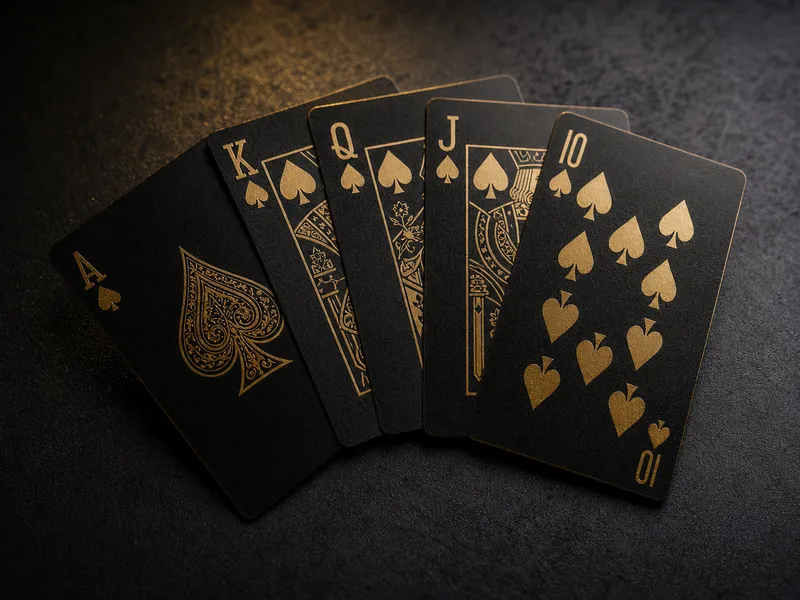
Spades
Quick Rules
- Two fixed partnerships sit across from each other; each player bids how many tricks they'll take, and partners' bids combine.
- Spades are always trump - the highest spade played beats any card of the led suit.
- Must follow suit if possible; spades can't be led until "broken" (played earlier when a player was void in the led suit).
- Meet or beat your team's combined bid: score 10 points per bid trick. Fall short: lose 10 points per bid trick instead.
- Extra tricks beyond the bid ("bags") score 1 point each, but every 10 bags a team collects costs 100 points.
How to Play (Quick Overview)
- 1
Deal all 52 cards evenly, 13 to each of 4 players seated in two fixed partnerships, partners sitting across from each other.
- 2
Before play, each player bids a number from 0 to 13 predicting how many tricks they'll win; a bid of 0 is called "nil." The two partners' bids combine into one team target.
- 3
The player to the dealer's left leads the first trick; other players must follow the suit led if they're able to.
- 4
Spades cannot be led until a spade has already been played on an earlier trick by a player who was void in the led suit ("spades broken"), except when only spades remain in every hand.
- 5
The highest card of the suit led wins the trick, unless a spade was played, in which case the highest spade played wins instead.
- 6
After all 13 tricks are played, compare each partnership's tricks won to their combined bid to score the hand.
Objective
Working with your partner across the table, predict exactly how many tricks your partnership will win, then take that many (or more, without leaving too many extras).
Setup
Shuffle a standard 52-card deck and deal all of it out evenly, 13 cards to each of 4 players. Seats alternate between the two partnerships, so each player’s partner sits directly across the table.
Before the first trick, every player privately decides and announces a bid: a number from 0 to 13 representing how many tricks they expect to win this hand. A bid of exactly 0 is called “nil” and carries its own bonus and penalty (see Scoring). The two partners’ individual bids are added together into one combined team target for the hand.
How to Play
The player to the dealer’s left leads the first trick. Other players must follow the suit that was led if they hold a card of it. If a player has none of the led suit, they may play any card, including a spade.
Spades are always trump. The highest spade played in a trick beats every card of the suit that was led, regardless of rank. If no spades were played, the highest card of the led suit wins as normal.
Spades can’t be led until they’ve been “broken” - meaning a spade has already been played on an earlier trick by a player who couldn’t follow the suit that was led that time. Once broken, spades can be led freely for the rest of the hand. The one exception: if a player’s entire remaining hand is spades, they’re allowed to lead one even if spades haven’t been broken yet.
Play continues until all 13 tricks have been taken.
Scoring
Compare each partnership’s total tricks won to their combined bid:
- Meet or beat the bid: score 10 points for every trick that was bid.
- Fall short of the bid: lose 10 points for every trick that was bid (a “set” or “bag out”).
- Overtricks (“bags”): tricks won beyond the combined bid score 1 point each - but are risky, since every 10 bags a partnership accumulates over the course of the game costs them 100 points.
- Nil bid: a player who bid 0 and takes zero tricks earns their team a bonus, commonly 100 points. If they take even one trick, their team loses that same amount instead. A partner’s own bid and tricks are scored separately from a teammate’s nil.
Winning
Hands are played one after another until one partnership reaches an agreed target score, commonly 500 points. That partnership wins the game.
Variations
- Whiz / Mirror: bidding variants that restrict or change how bids can be made based on your hand’s spade count.
- Cutthroat Spades: played by 3 or 4 individuals with no partnerships, everyone for themselves.
- Suicide Spades: one player per partnership is required to bid nil each hand.
History
Spades is a relatively young trick-taking game by card-game standards, generally believed to have been invented in the United States sometime in the 1930s. It’s thought to have started among college students looking for a faster, simpler alternative to Bridge and Whist - both hugely popular at the time, but built around complex bidding systems. The game picked up considerable momentum in the U.S. military during the mid-20th century, since it was quick to teach and play in short breaks, and service members carried it home and spread it further after their tours.
Fun Fact
Unlike Bridge, where the trump suit is decided fresh through elaborate bidding every single hand, Spades fixes the trump suit permanently - spades, always - a deliberate simplification that’s the main reason it’s so much faster to teach a new player than its more complex trick-taking relatives.