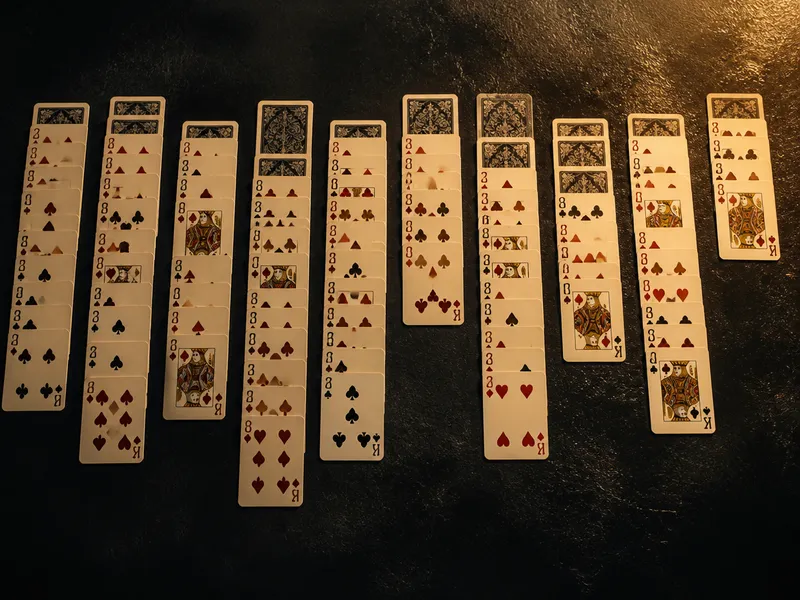
Spider Solitaire
Quick Rules
- Deal 10 tableau columns from two shuffled decks; only the top card of each column starts face up.
- Move cards in descending order within the tableau - suit doesn't matter for the move itself, only for removing a full run.
- Complete an unbroken King-to-Ace run in a single suit to remove it from play automatically.
- No foundations to build up - you win by clearing all 8 same-suit runs off the tableau entirely.
- When the tableau is stuck, deal one new card face up onto every column from the stock (all 10 at once).
How to Play (Quick Overview)
- 1
Shuffle two 52-card decks together (104 cards) and deal 10 tableau columns: the first 4 columns get 6 cards each, the remaining 6 columns get 5 cards each - only the top card of every column is face up.
- 2
Place the remaining 50 cards face down as the stock, split into 5 batches of 10.
- 3
Move a face-up card, or a valid face-up sequence of the same suit in descending order, onto another column's top card if it's exactly one rank higher, regardless of that card's suit.
- 4
Whenever moving a card exposes a face-down card underneath, flip it face up.
- 5
Whenever a full King-to-Ace sequence of the same suit is assembled in one column, it's automatically removed from the tableau and set aside as completed.
- 6
When no more tableau moves are available, deal one card face up onto every column at once from the stock (this uses up one full batch of 10) - you cannot deal from the stock if any column is completely empty.
Objective
Clear the entire tableau by assembling all 8 complete King-to-Ace runs, one suit at a time, and removing them from play.
Setup
Shuffle two standard 52-card decks together, for 104 cards total. Deal 10 columns to form the tableau: the leftmost 4 columns get 6 cards each, and the remaining 6 columns get 5 cards each. In every column, only the top card is dealt face up; everything under it stays face down. Set the remaining 50 cards aside as the stock, informally grouped into 5 batches of 10 cards each (one for each time you’ll deal into the tableau).
How to Play
Unlike most solitaire games, Spider has no foundation piles to build up separately - your goal is entirely about the tableau itself.
You may move a face-up card, or an entire face-up sequence of cards of the same suit in descending order, onto another column if the card it’s landing on is exactly one rank higher - regardless of that target card’s suit. (A same-suit sequence can be moved as one unit; a mixed-suit sequence that’s only in descending rank order, without matching suit, can only be moved one card at a time.)
Whenever a move exposes a face-down card, flip it face up - it immediately becomes available to play.
Whenever you manage to arrange a complete, same-suit run from King down to Ace in a single column, it is automatically lifted off the tableau and set aside as done - one of the 8 runs you need to clear the whole game.
When you’re stuck and have no useful tableau moves left, deal from the stock: one card face up is added to the top of every column at once, using up one of your 5 batches of 10. You’re not allowed to deal from the stock while any column is completely empty - clear a column first, or use a different stock batch’s timing to your advantage.
Scoring
Traditional Spider Solitaire has no point score - it’s simply won or lost as a single game. Digital versions sometimes track a move count or start you with a fixed score and deduct points for each extra move, but this isn’t part of the base game.
Winning
You win once all 8 King-to-Ace runs have been completed and removed from the tableau, clearing it entirely. If you run out of stock deals and legal tableau moves before finishing, the game is lost.
Variations
- One-suit Spider: uses only Spades (or any single suit) across both decks, making every card match, which is considerably easier than the standard 4-suit or 2-suit versions.
- Two-suit Spider: a common middle-difficulty version using two suits instead of all four.
- Four-suit Spider: the hardest common version, using all four suits across both decks, exactly as described above.
History
Spider Solitaire is a considerably more modern addition to the solitaire family than games like Klondike, first noted in print in the mid-20th century but reaching mass popularity specifically through its inclusion as a built-in game on Windows PCs starting with Windows Me and continuing through Windows XP, where it became one of the most-played default games bundled with the operating system.
Fun Fact
Solving a full 4-suit Spider Solitaire game is considerably harder than Klondike, since 104 cards are spread across only 10 columns, forcing players to plan same-suit runs across two decks’ worth of duplicate cards at once - a large part of why the game offers 1, 2, and 4-suit modes of increasing difficulty rather than a single fixed version.