Truco
Also known as: Truco Argentino
Quick Rules
- Uses a 40-card Spanish deck; a fixed hierarchy of cards (led by the 1 of swords, then 1 of clubs, then the 7s) beats normal rank order.
- Each hand is best-of-3 rounds ("manos"); win 2 of the 3 to win the hand.
- Any player can call "Truco" to raise the hand's stakes before it's decided - opponents must accept, raise further ("Retruco," "Vale Cuatro"), or fold and concede the points.
- Alongside Truco, players can also bet on their own hand's card strength by calling "Envido" before the first round is played, scored separately from the trick points.
- First side to reach the target score (commonly 15 or 30 points) wins the game.
How to Play (Quick Overview)
- 1
Deal 3 cards to each player from the 40-card Spanish deck (the 8s, 9s, and jokers are removed before play).
- 2
Before the first trick, any player may call "Envido" to bet on the point value of their own two same-suit cards; opponents can accept, raise ("Real Envido," "Falta Envido"), or decline, scoring points separately from the main hand.
- 3
Play the first of 3 rounds ("manos"): each player plays one card, following the special Truco card ranking rather than normal rank order, and the highest card wins that round.
- 4
At any point before the hand is decided, a player may call "Truco" to raise the stakes of the whole hand; the other side must accept (raising the value to 2 points), decline (conceding 1 point and ending the hand), or counter-raise ("Retruco," then "Vale Cuatro").
- 5
Play all 3 rounds; whichever side wins 2 of the 3 rounds wins the hand and scores it at whatever stake level Truco calls have raised it to.
- 6
Deal the next hand, with the dealer position rotating, and continue until one side reaches the target score.
Objective
Win hands by taking 2 of the 3 rounds dealt each time, while using bluffing and betting calls (Truco and Envido) to raise the value of a hand you’re confident about, or scare opponents out of one you’re not.
Setup
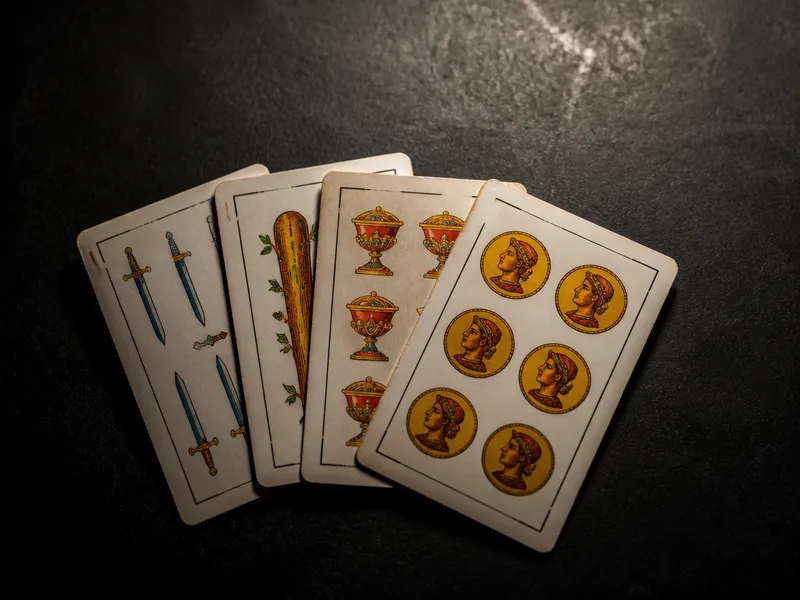
Truco is traditionally played with a 40-card Spanish-suited deck (no 8s, 9s, or jokers). It can be played 1-on-1 or in partnerships of 2-on-2. Deal 3 cards to each player.
How to Play
Card ranking (unusual). Truco uses its own fixed hierarchy rather than standard rank order. From highest to lowest, the top cards are: 1 of swords (“macho”), 1 of clubs, 7 of swords, 7 of coins, then the three 3s, then the four 2s, then the remaining Aces, then Kings, Knights, Jacks, and finally the plain 7s, 6s, 5s, and 4s.
Envido. Before the very first card of the hand is played, any player may call “Envido,” betting on the combined value of their two cards that share a suit (a third unmatched card doesn’t count). Opponents can accept the bet, decline it, or raise it further with calls like “Real Envido” or “Falta Envido.” Envido points are scored separately from the main hand and are settled before the first round is played.
Playing the rounds. The hand itself is decided over 3 rounds (“manos”). Each round, every player plays one card, and the highest-ranked card by the special Truco order wins that round. Whichever side wins 2 of the 3 rounds wins the hand.
Truco calls. At any point before the hand is fully decided, a player may call “Truco” to raise the stakes of the entire hand from its base value of 1 point up to 2. The opposing side must respond: accept the new stake and keep playing, decline and concede the 1 point the hand was worth before the call, or raise further with “Retruco” (to 3 points) and then “Vale Cuatro” (to 4 points), each of which the other side can again accept, decline, or re-raise.
Scoring
Each hand is worth its current stake level (1 point by default, or more if Truco was called and accepted) to whichever side wins 2 of the 3 rounds. Envido bets are scored on top of this, separately, based on which side had the higher-value Envido hand (or won by the other side declining the bet).
Winning
Play continues, hand after hand, with points accumulating from both Truco hands and Envido bets. The first side to reach the target score - commonly 15 or 30 points, depending on the region - wins the game.
Variations
- Truco Paulista / Truco Gaúcho (Brazil): regional Brazilian variants with different card rankings and bidding call names than the Argentine/Uruguayan version described above.
- Truco Uruguayo: similar to the Argentine version above with minor differences in Envido calls and betting structure.
- Flor: an additional bet available in some regional rule sets, called when a player holds three cards of the same suit, resolved similarly to Envido.
History
Truco descends from the Spanish game Truc, brought to South America by Spanish colonists, where it evolved separately in different countries into related but distinct national versions - Argentine and Uruguayan Truco, and a further-diverged Brazilian tradition (Truco Paulista and Truco Gaúcho). It remains one of the most widely played card games across the Southern Cone of South America.
Fun Fact
Truco is as much a game of table talk, gestures, and bluffing signals between partners as it is about the cards themselves - many regional versions have well-established (if technically against strict tournament rules) hand signals partners use to secretly share information about their hands, adding a whole layer of social gameplay beyond what’s printed in any rulebook.