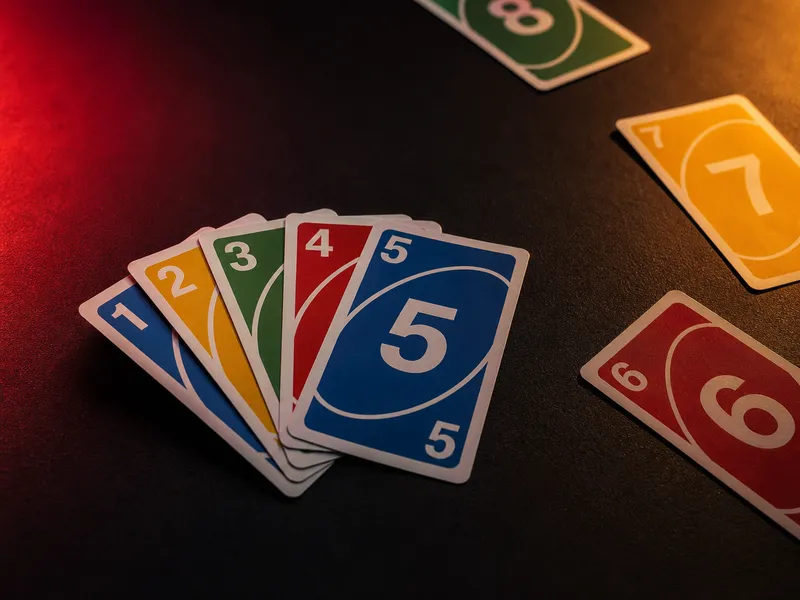
Uno
Quick Rules
- Match the top discard card by color, number, or symbol, or play a Wild card.
- Draw Two makes the next player draw 2 cards and lose their turn; Wild Draw Four does the same for 4 cards and lets you name the color.
- Skip and Reverse change turn order; a plain Wild card just lets you choose the next color.
- Say "Uno" out loud when you play your second-to-last card - get caught before your next turn and you draw 2 penalty cards.
- First to empty their hand wins the round; play multiple rounds to a target score for a full game.
How to Play (Quick Overview)
- 1
Deal 7 cards to each player. Place the rest face down as the draw pile and flip the top card to start the discard pile (reshuffle if it's a Wild Draw Four).
- 2
On your turn, play a card matching the top discard's color, number, or symbol, or play a Wild card of any color.
- 3
Action cards apply immediately: Skip skips the next player, Reverse flips the direction of play, Draw Two forces the next player to draw two cards and lose their turn.
- 4
Wild lets you name the next color to be played; Wild Draw Four does the same and forces the next player to draw four cards and lose their turn.
- 5
If you can't play a legal card, draw one from the draw pile. Play it immediately if it's legal, otherwise your turn ends.
- 6
When you play your second-to-last card, say "Uno" - if another player catches you before your next turn begins, you must draw two penalty cards.
Objective
Be the first player to play every card in your hand.
Setup
Shuffle the 108-card Uno deck. Deal 7 cards to each player. Place the remaining cards face down as the draw pile, then turn the top card face up to start the discard pile. If that first card is a Wild Draw Four, shuffle it back into the deck and flip a new card instead, since it can’t legally be played as the very first card.
How to Play
Play moves clockwise, starting with the player to the dealer’s left, unless a Reverse changes the direction. On your turn, play a card from your hand that matches the top discard card by color, number, or symbol - or play a Wild card, which matches anything.
Action cards resolve immediately when played:
- Skip: the next player loses their turn entirely.
- Reverse: the direction of play flips (clockwise becomes counter-clockwise, or vice versa). In a two-player game, Reverse acts like a Skip instead.
- Draw Two: the next player must draw two cards from the draw pile and their turn is skipped.
- Wild: you name the color that must be matched next, regardless of the card’s own printed color.
- Wild Draw Four: as above, but the next player also draws four cards and loses their turn. Official rules say you should only play this card if you have no card of the current color in your hand - if challenged and found to have one, you draw four cards instead of the next player.
If you have no legal card to play, draw one card from the draw pile. If that card can be played, you may play it right away; otherwise your turn ends.
The moment you play the card that leaves you with exactly one card left, you must say “Uno” out loud. If another player notices you didn’t and calls you out before your next turn starts, you must draw two penalty cards.
Scoring
Uno can be played as a single round (first to empty their hand wins outright) or scored across multiple rounds to a target, commonly 500 points:
- Number cards: face value
- Draw Two, Skip, Reverse: 20 points each
- Wild: 50 points
- Wild Draw Four: 50 points
When a round ends, the winner scores the total value of every card left in every other player’s hand. Play continues, round after round, until one player’s cumulative score reaches the target.
Winning
Each round is won by the first player to play their last card. If you’re playing to a target score, the first player to reach it across multiple rounds wins the overall game.
Variations
- Stacking: some house rules let you stack a Draw Two on a Draw Two (or a Wild Draw Four on a Draw Two), passing the penalty along instead of taking it - this is not part of the official rules and should be agreed before play.
- 7-0 rule: playing a 7 lets you swap hands with any player; playing a 0 passes every player’s hand one seat in the current direction of play.
- Jump-in rule: any player holding a card that’s an exact match (same color and number) to the current discard can play it out of turn, jumping the action to the player after them.
History
Uno was created in 1971 by Merle Robbins, a barber in Reading, Ohio, who developed it with his family as a more structured take on the older shedding game Crazy Eights - replacing suit-matching with color-matching and turning informal house rules into dedicated printed action cards (Skip, Reverse, Draw Two, Wild). Robbins initially self-published and sold the game out of his own barbershop before selling the rights in 1972 to a family friend, who founded International Games, Inc. to manufacture and distribute it nationally. Mattel acquired the Uno brand in 1992 and has published it ever since.
Fun Fact
Uno’s official rules state that a Wild Draw Four can only legally be played when you have no card of the current color in your hand - the widely ignored “play it whenever you want” house rule is, by Mattel’s own account, the single most common real-world rules dispute the game generates.
More to Explore
Uno is a trademark of Mattel. This page is an independent rules reference and is not affiliated with, endorsed by, or sponsored by Mattel.